The life and times of a normal university student

05 May 2014

A Hard Place, or, The Future Scares Me -- Ninety Sixth Post

I'm going to assume that anyone who's found my blog is internet-savvy enough to have stumbled across the brilliant work of Allie Brosh at hyperboleandahalf.blogspot.com and has also read her pieces on depression. I'm not going to lie, they hit me right in the feels. My family has had struggles with depression and anxiety and panic attacks and all the things that a lot of people seem to think aren't "real" illnesses, and an odd phenomenon I've run across is the coolness of suicidal thoughts and self-harm and all that horrible, painful stuff that so often tags along with mental illnesses.
I will admit right here and now to having been a dumb emo teenager with poetic aspirations who wrote really stupid poetry romanticizing people who kill themselves. And I'm sorry.
As a former emo, I can quantitatively say that this is true.

However, my idiotic poetry (which trailed off around age 18 when I got a part-time job and didn't spend 8 hours of every day around other high schoolers), while stupid and indicative of a dangerous trend among youth (darn kids *shakes fist*), doesn't invalidate the fact that I have experienced some horrible feelings and been in hard places. 
I don't have a documented mental illness. I did see a therapist when I was 13 or 14 for some suicidal feelings, but it's been pretty smooth sailing on the mental health front since my therapist taught me coping mechanisms. For people without mental illnesses, overcoming a depressed emotional state can really be as easy as talking through our feelings and learning how to cope with an excess of sad emotions. Sometimes, talk therapy works for people with mental illnesses as well, but sometimes it doesn't. Brains are weird things, and it can take a lot of persuasion to get them to work with you again once they've decided to work against you. 
I've seen my dad, who had always been the strong person in my life, curled up in bed because of panic attacks. You can't just "have a positive outlook" when the dark corners of your brain have you in their grip and getting out of bed is literally impossible. I know a person who would get home from class, turn on all the lights, and hide under a blanket in the middle of the room until her roommates got home because the chemical imbalance in her brain made being alone in the dark the worst possible thing. There was nothing that a "positive thinking" website could have told her that would make it better, no hopeful thoughts that could penetrate the horrors that her mind cooked up to hold her captive. Mental illnesses are a bitch, to put it mildly, and it seems like a lot of "society at large" views them as simply a lack of willpower. That makes me angry, on behalf of everyone who's ever been afraid to share that they're scared of their own mind and everyone who's ever been told to just try harder and think positive and just get out of bed. 
I've cried myself to sleep because the future is long and scary. I'm 23 now, and if I live to be 80, as all my grandparents have done, I'll have almost 60 more years of living. What the hell am I going to do with 57 more years? I ask you. I've got a pretty good idea about the next 5 or 6 (be in grad school), but that's about as far ahead as I can really look without getting a headache. It's a long time to live, and it scares me. 
I view death as a kind of sleep, where you finally get to rest after all the shit life puts you through. I'm not saying people should hurry along to death, because there's wonderful things in life that you don't want to miss out on, but it's like going to sleep after a very long week. Good things and bad things happen, and life has a way of wearing you out. 
If this is how I feel when I'm at the beginning of my adult life, how bad is it going to get when I actually have a daily grind that will extend on for another thirty years or so? Oh my god thirty years is a long time.
How do other people deal with the yawning abyss that is our futures? If we're shooting for the moon and landing among the stars, I feel like I'm passing dangerously close to a black hole.
That whole analogy is ridiculous, of course, since missing the moon doesn't really get you any closer to the stars. Those are very far away. 
This was a terrible post to edit right before bed.
Anyway, to end this on a less distressingly negative note, the future isn't hopeless. I know this. I spend most of my time relatively content and occasionally even excited about whatever's coming next, it's just that the midnight existential crises are more memorable and terrifying. If you're scared of the future, reach out to someone. If you think you might have a mental illness of some kind, find yourself a licensed professional to talk to. Don't count on friends and family for talk therapy, because they'll probably be shocked and fall back on the "just try to be happy" line (unless you happen to have a licensed therapist in your friends and family, but talking to people you don't know is still often better). If you're in a good place with your friends and family you should definitely reach out the them, but know that sometimes paying a stranger to help you in your struggle with your brain is the best option.
I don't have a very lively comment community like some of the cooler blogs, but you can always contact me through the comments if you're scared and alone. I'll read your message and feel some of your pain because I'm stupidly empathetic and try to write you something thoughtful and helpful and non-judgemental. It'll probably take me a couple of days to get back to you because I'll spend a lot of my time agonizing over what I'm writing. My point is, there are a lot of people who've felt feelings like the ones that make you feel alone and scared, and you're not really alone in all this. Maybe it's cold comfort, having someone who sees her future like a black hole tell you that she'll be there for you, but it's always helped me to learn that I'm not alone.

You are not alone.

31 March 2014

Guerrilla Gardening Post of the Whenever I Get Around to Posting: Urban Homesteading -- Ninety Fifth Post

I've recently become enamoured with the concept of urban homesteading, thanks to Bad Mama Genny. My problem is that, when looking for information about ways to get involved with this whole urban homestead thing, most people who put their information on the internet have honest-to-god homesteads that happen to be crammed into an urban setting. I'm not just talking about massive gardens, these people have chickens. And goats. And they homebrew and make their own clothes. Alternatively, they post things like "line dry your clothes" which I already do because the tag tells me to and "make your own laundry detergent" which I refuse to do because I like clothes that don't turn grey. It's also cheaper to buy cheap detergent than it is to buy the ingredients for detergent. "Stuff I have around the house" includes baking supplies, very few cleaning supplies, and zero essential oils. I'm twenty-three, in graduate school, and overly sensitive to strong smells.
So, on the list of "urban homesteading things I want to do," you will find making cheese, making kefir, making yogurt, canning/preserving lots of food over the summer and eating it over the winter (I want to be a locavore so badly but I live in a place with a five-month growing season so that's not going to happen any time soon), homebrewing beer, wine, and hard cider, pressing my own cider, making ten tons of jam, making bread from my own sourdough starter, growing my own food, lactofermenting everything, and sprouting all my grains and legumes before cooking them.
While I have the capability to do pretty much all of these things, even if I don't yet have the equipment, I have two shelves in a small pantry for all my food and I share a standard-size fridge and small freezer with three other people. This equates to having no space for food preservation. I've had some luck with sprouting beans and rice, so the sprouting thing isn't a total loss. All that's left is gardening, which I love, but I have one little problem.
I don't have a yard. There is a very nice west-facing grassy area where everyone in this little strip of four-plexes and two-story apartments walks their dogs and then doesn't clean up their shit, but that's it. The east-facing front yard is 90% driveway, 5% "on the north side of the neighbor's garage," and 4.5% trees and landscaping features. The south side of the building is three units down, so that's out. We do get the north side of the building. Yay, full shade plants!
Bok Choy seedlings demonstrating the value of full shade plants by sitting in a rainy window and doing pretty damn good, if I do say so myself.
So. I have a cement pad that faces west, a west-facing window, the north side of a building, and a heavily-shaded front walk with some eastern exposure and possibly some overhead exposure during the summer.
As the old saying goes, For root or fruit, sun all day; for leaves, shade's okay! or something to that effect. It's supposed to rhyme, and I have zero sense of what rhymes with what. Anyway, the point is that leafy greens are best grown in cool weather in the shade, and anything with an edible root (carrot, potato, radish, parsnip, beet, etc) or seed-containing fruit (such as squash, eggplant, tomato, cucumber, berries, etc) should get full sunlight.
The north side of the building is going to be home to pots with cool-weather, shade-loving crops: celery, and assorted greens including kale and bok choy. These might live on the west side along with peas until it gets too hot and bright.
The west-facing cement pad gets three pots with sun-long, warm weather crops: an eggplant, a tomato, and a zucchini along with carrots, parsnips, beets, and marigolds. Other flowers or herbs might be added in as I find out what companion plants appeal to me.  When it gets too hot for the peas, I'll plant beans in their pot.
The front walk might get one of the sun-lovers once the sun makes its way back up to the northern hemisphere, and it might also be a staging area for the cool-weather crops, since they should probably get at least a little sun. In fact, that's probably where the peas are going to live, along with some daikon radishes.
Because I am impulsive, I have a small problem in paradise: I have a pot with celery, kale, parsnips, and daikon radishes. This happened before I found out that root crops need sunshine, too, and also before I found out that celery counts as a leafy green in that it loves shade. My thought process was that if radishes are cool-weather crops (they are), like leafy greens, then they probably like shade, right? And I really want parsnips right fucking now. Oh, hey, kale seeds!
Note the radish sprouts searching desperately for sunshine.
Oops.
Anyway, I'll get to find out if root vegetables can survive me transplanting them.

Now, on to the entire reason that I sat down to write this post: what the hell can I get away with growing in a container?
Lots, actually. Pretty much every edible plant can be grown successfully in a container, including corn and potatoes. Tomatoes, eggplants, cabbage, cucumbers, summer squash, peas, beans, all manner of leafy greens, and most root vegetables will do pretty well in pots; I'm less certain about large viney squash and melons.
And now, for your gardening pleasure, a by-no-means-comprehensive list of plants that are allegedly happy in containers, with the varieties of each plant that are sold as "compact," "dwarf," or "good for containers" included. Full disclaimer: I have attempted to grow exactly none of these. This list also doesn't discriminate between hybrids and heirloom varieties, either.

Photo from www.grow-it-organically.com

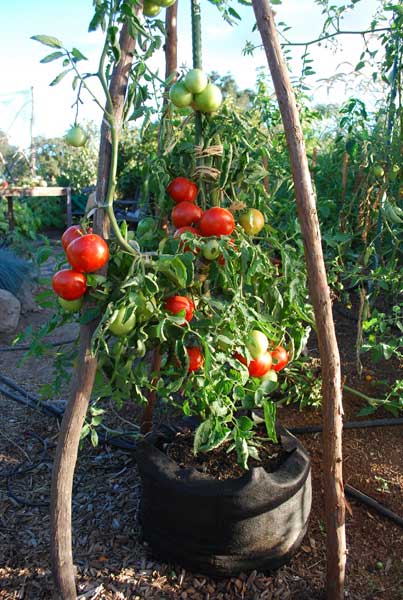
  • Tomatoes: look for dwarf, determinate, bush types if size is a HUGE problem (ahahaha no pun intended), but indeterminate types can grow in any pot if it's big enough. The internet highly advises us to seek out heirlooms, especially indeterminate kinds that are "well-behaved" in pots because the flavor is said to be much better than dwarf types. Many of the varieties on this list are indeterminates that have grown well in pots. 
    • Black Krim
    • Japanese Black Trifele
    • Sungold (cherry)
    • Wapsipinicon Peach (fuzzy)
    • Stupice (I'll be growing this one)
    • Silvery Fir Tree
    • Brandywine
    • Riesentraube (cherry/grape)
    • Cherokee Green (green tomato)
    • Polish Linguisa (paste)
    • Hahms Gelbe Topftomate (cherry)
    • Black Seaman's
    • Czech's Bush
    • Sophie's Choice
    • Whippersnapper (cherry)
    • Korlik (cherry)
    • Principe Borghese (cherry)
    • Supersweet 100
    • Manitoba
    • New Yorker
    • Blue Champion
    • Green Zebra
    • Paul Robeson
    • Carmello
    • Baxter's Early Bush Cherry
    • Elfin
    • Lyana
    • Micro Tom
    • Patio F
    • Red Robin
    • Tiny Tim
    • Totem
    • Yellow Pygmy
http://www.treehugger.com/lawn-garden/10-tomatoes-grow-your-container-garden.html
http://www.hgtvgardens.com/tomatoes/which-tomatoes-to-grow-on-my-patio
http://containergardening.about.com/od/containergardening101/f/Tomato_Varieties.htm
http://tomatoheadquarters.com/container-gardening-2/growing-heirloom-tomatoes-in-pots/
http://www.tomatodirt.com/growing-tomatoes-in-pots-small-containers.html

Photo from www.grow-it-organically.com

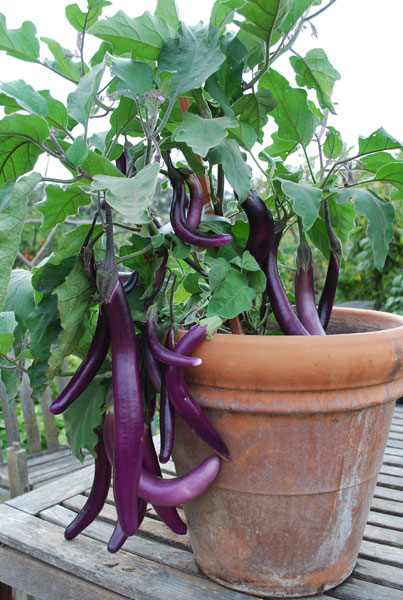
  • Eggplant: I'm not a fan of eggplant from the store, but those are always the big fat overripe purple ones. This is a problem because I'm a vegetarian, and eggplant is sort of the vegetarian steak (LIES it is not like steak at all! Eggplant is pretty damn bland all by its lonesome; please do not serve "eggplant steaks" or "eggplant sandwiches" to vegetarians unless we express definite interest), so I intend to find a variety of eggplant that I like. Represented here are some lighter-colored and/or less fat varieties. Japanese eggplants are also nice because they are slender and not huge and fat. I'm currently attempting to germinate "Long Purple" seeds; the experiment will continue until I find one I like or give up on eggplant altogether. 
    • Fairy Tale
    • Hansel
    • Gretel
    • Rosa Bianca
    • Little Fingers
    • Orient Express
    • Applegreen
    • Beatrice
    • Purple Fingerling
    • Calliope
    • Orlando
    • Bambino (Baby Bell)
    • Bride Asian
    • Ophelia
http://containergardening.about.com/od/vegetablesandherbs/a/How-To-Grow-Eggplant-In-Containers.htm
http://www.motherearthnews.com/organic-gardening/eggplant-at-a-glance-zm0z12djzkin.aspx#axzz2xJocAEto
http://www.vegetablegardener.com/item/10658/have-a-small-space-garden-try-dwarf-vegetable-varieties
http://www.extension.iastate.edu/Publications/PM870B.pdf

Photo from http://blog.seattlepi.com/

  • Cucumbers: non-bush varieties can be trellised, but bush varieties are naturally compact and don't require as much vertical space. I desperately want a bush pickle variety, but I don't know if I'll actually enjoy homemade pickles so I'm practicing self-control and waiting until next year while I invest a small amount of time, effort, and money on one batch of homemade pickles with store-bought cukes. 
    • Salad Bush Hybrid
    • Bush Champion
    • Picklebush
    • Spacemaster 
    • Hybrid Bush Crop
    • Midget Bush Pickler 
    • Bush Pickle
    • H-19 Little Leaf
    • Bush Crop
    • Salad Bush
    • Patio Pickle
  • Squash, separated by winter and summer squash varieties. Winter can be harvested in the fall and stored someplace cool for months, while summer goes bad a few days off the vine and is best when small and tender. Anything that doesn't say "bush" will almost certainly vine, except the zucchinis, which are always bushes. 
    • Burpee's Butter Bush (winter)
    • Burpee's Bush Table Queen (winter)
    • Bushkin Pumpkin 
    • Jackpot Pumpkin
    • Spirit Pumpkin
    • Baby Bear Pumpkin
    • New England Pie Pumpkin
    • Sugar Treat Pumpkin
    • Jack-Be-Little Pumpkin
    • Sweetie Pie Pumpkin
    • Aspen Pumpkin
    • A&C Hybrid #300 Pumpkin
    • Jack of All Trades Pumpkin
    • Harvest Moon Pumpkin
    • Bush Acorn (winter)
    • Bush Crookneck (summer)
    • Hybrid Jackpot Zucchini 
    • Black Magic Zucchini (I'll be growing this one)
    • Gold Rush Zucchini
    • Peter Pan Scallop (summer)
    • Sunburst Scallop (summer)
    • Dwarf Summer Crookneck (summer)
  • Melons: they still vine, as far as I can tell, so indoors or shared spaces are probably not good places to plant melons, unless you have the time and supplies to convince them to go vertical. Sigh. There are few things nicer than a cantaloupe when it's still warm from the sun.
    • Sugar Baby Watermelon
    • Golden Midget Watermelon
    • Yellow Doll Watermelon
    • Honey Red Watermelon
    • Minnesota Midget Cantaloupe
    • Emerald Green Cantaloupe
    • Green Nutmeg Cantaloupe
    • Golden Jenny Cantaloupe
    • Petit Gris de Rennes Cantaloupe
    • Sakata's Sweet Cantaloupe
    • Sleeping Beauty Cantaloupe
    • Savor Cantaloupe
    • I looked for dwarf/miniature honeydew melon varieties and couldn't find any listed, although every site that talks about growing melons in containers mentions dwarf honeydew varieties. Heckle your local garden store employees (not hardware-store-that-happens-to-sell-garden-supplies employees, though) if you're desperate for homegrown honeydews. 
  • Beans: pole beans will grow happily in containers if provided with a something to grow up, so they are perfect if you have lots of vertical space.  Bush beans are naturally compact but require more horizontal space, so they're ideal for people without much vertical space.
    • Derby (bush)
    • Provider (bush)
    • Topcrop (bush)
    • Royal Burgundy (bush)
    • Dragon's Tongue (bush) (I'll be growing this one)
    • Tongue of Fire (bush)
    • Cherokee Trail of Tears (bush) (also: nothing like a little white guilt with your dinner)
    • Trionfolo Violetto (pole)
    • Scarlet (pole)
    • Sunset (pole)
    • Golden Sunshine (pole)
    • Chinese Long/Yard Long (pole)
    • Contender
    • Blue Lake 247
    • Tendergreen Improved
    • Kentucky Dreamer
    • Slenderette
  • Beets: any variety should grow pretty well in containers if given enough space, or else the bulb won't develop. I desperately want to like beets. They are so healthy, but I've had exactly one good experience with beets, and that was in an "apple and beetroot juice" when I was roaming London with a nasty cold after my computer got stolen in the last week of my five-month semester abroad. If any part of the beet is involved other than its juice (no pulp, either, thanks), I don't like it. But, but, healthy! So I'll be growing Cylindra in a hail-mary attempt to like them because I grew them. The logic here is flawed, I know. But, beets should do well in Montana and I do tend to like vegetables that I've grown myself more than storebought ones. 
    • Red Ace
    • Ruby Queen
    • Cylindra (I'll be growing these: they are carrot-shaped, not globes, so they do better in smaller spaces)
http://www.extension.iastate.edu/Publications/PM870B.pdf
http://www.seedsnow.com/products/beet-cylindra

BEET UPDATE: Roasted beets are fucking delicious. I got one at the Winter Farmer's Market. Here is how I cooked it:
1. Wash off all the dirt, cut off the tops, and cut into chunks. DO NOT PEEL!
2. Place in a pan on parchment paper, drizzle with oil, and sprinkle on a bit of salt (season to taste, in other words). 
3. Roast at, say, 350 F until you can stab them pretty easily with a fork. My beet took something over half an hour for large-garlic-clove-sized chunks. The same method should work on the grill if you wrap them in foil 
4. Devour, skin and all. 
5. Be amazed at how tasty beets can be, because damn.
I think the difference is that it wasn't canned or preserved in any way, which is the only way I've ever had beets (aside from juiced). Night and day, man. Night and day. 


Photo from http://mytinyplot.com/

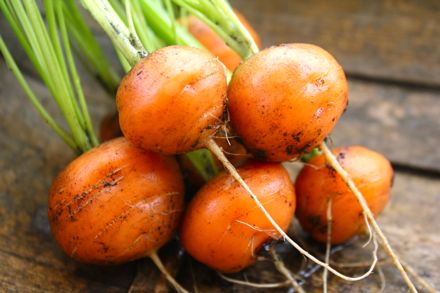
  • Carrots: the only limitation is the size of your pot. If it's too shallow, the carrots will just be shorter. If you're really nervous about this, go for one of the round varieties (I've included one on the list) and remember that you don't have to peel it if there's nothing particularly nasty in your dirt. 
    • Danver's Half Long
    • Little Finger
    • Nantes Half Long
    • Scarlet Nantes (I'll be growing these)
    • Chantenay Red Core
    • Adelaide
    • Paramex (round)
    • Flyaway
    • Maestro
  • Greens: have nice shallow root systems, so they work really well in containers. They also like shade, another plus for the indoor gardener or the heavily-shaded gardener. Not so good for the gardeners with full sun and only full sun. I really only included this list for people who can't function without lists. 
    • Lettuce
      • Black Seeded Simpson
      • Green Ice
      • Green Salad Bowl
      • Red Sails
      • Red Salad Bowl
      • Buttercruch
      • Tom Thumb
    • Spinach
      • Long Standing Bloomsdale
      • Melody
      • Tyee
      • Renegade
    • Swiss Chard
      • Fordhook Giant
      • Lucullus 
    • Kale
      • Dwarf Blue Scotch
http://www.ufseeds.com/Container-Gardening-Vegetables.html

  • Cabbage: I'm completely sold on the benefits of lactofermented sauerkraut, but I'm not ready to plunk down a lot of time and effort on a plant that I might not have a use for. I certainly don't have space for it. Anyway, cabbages will grow happily in containers, but I've tried to include mostly little guys to make up for the other vegetables where I couldn't find much information on size. In the space I've got, I'd only have space for one plant anyway.

  • Photo from www.grow-it-organically.com
    • Baby Head 
    • Dwarf Morden
    • Minicole
    • Fast Ball
    • Flash
    • Parel
    • Gonzales
    • Red Express
    • Savoy Express (not a head cabbage)
    • Primero
    • Ruby Ball
    • Kaitlin
    • Danish Ballhead
    • Storage No. 4

http://ohioline.osu.edu/hyg-fact/1000/1647.html
http://www.grow-it-organically.com/cabbage-varieties.html

Photo from http://www.gardeningclub.com/

  • Corn: still needs vertical space, and you should plant multiple plants within a few feet of each other so they can pollinate each other. Stick with one variety, though, because corn plays fair with mendelian genetics and can make some horrible hybrids. 
    • Kandy Korn
    • Early Gold Bantam
    • Sweet Spring Treat (short)
    • Sweet Painted Mountain (short)
    • Trinity (short)
    • Chires Baby Sweet (short) 
  • Broccoli: just in case you're interested. I'm not growing any because I'm not big on broccoli. 
    • Calabrese
    • Waltham 29
    • Coronado Crown
  • Cauliflower: like broccoli, I'm not that big on growing it myself. It takes up a lot of space and you only really get one harvest per plant. 
  • Photo from http://janedata.wordpress.com/

    • Snow Crown
    • Early Dawn
    • Early Snowball
  • Peas: yet another plant that should grow well in containers regardless of variety. Look for compact types if vertical space is an issue, or you don't want the hassle of trellising and staking. Some of these require trellising.
  • Photo from www.burpee.com
    • Little Marvel (I'll be growing these)
    • Sugar Snap
    • Tom Thumb
    • Early Frosty
    • Oregon Sugar Pod
    • Markana
    • Gemini
    • Snow peas in general
    • Sugar Snap-type peas in general
    • Burpee's Peas-in-a-Pot (I am all kinds of getting these next year)
  • Potatoes: pretty much any potato, including sweet potatoes, will grow happily in grow bags or large buckets. Just remember to plant your seed potatoes at the bottom of the container and gradually add more dirt as the plants get taller. Potatoes love being in hills. However, here's a few varieties that are supposed to grow especially well in containers. I'll be growing some purple fingerlings that I got from the winter farmer's market because I'm a rebel. 
    • Red Pontiac
    • Kennebec
    • Yukon Gold
    • Adirondack Blue
  • Radish: I only like daikon radishes cleverly cooked into delicious foods, not spicy raw radishes. If you're into the little round spicy kind, pretty much any of them can be grown in containers. The only problem with daikons is that you need a nice deep pot, which I have. Here are a few varieties for the list-dependent who don't know if they like radishes yet. 
    • Cherry Belle
    • Easter Egg
    • Champion
  • Pepper: I don't even like bell peppers 99% of the time. I'll eat the damn things if they're in my food or offered to me, but I don't do spicy peppers at all. I put this list here because I'm a nice person and also a masochist. 
    • Anaheim Chili (hot)
    • Sweet Banana (mild)
    • Early Jalapeno (hot)
    • Corno Di Toro (frying, whatever that means)
    • Cubanelle (hot)
    • Cherrytime (hot)
    • Apple (hot)
    • Red Cherry (hot)
    • Red Chili (hot)
    • Lady Bell (bell)
    • Gypsy (mild)
    • Crispy (mild)
    • New Ace (bell)
    • Bell Boy (bell)
    • Sweet Chocolate (bell)
    • California Wonder (bell)
    • Early Thickset (bell)
http://www.ufseeds.com/Container-Gardening-Vegetables.html
http://www.ifplantscouldtalk.rutgers.edu/planttalk/article.asp?ID=17


  • Berries: since berries are perennials, you'll have to figure out how to overwinter them if you live in a cold climate. Because pots are exposed on all sides to the cold, the soil is more likely to freeze solid and kill your plants. However, most berries will grow happily in pots provided you keep them warm enough.
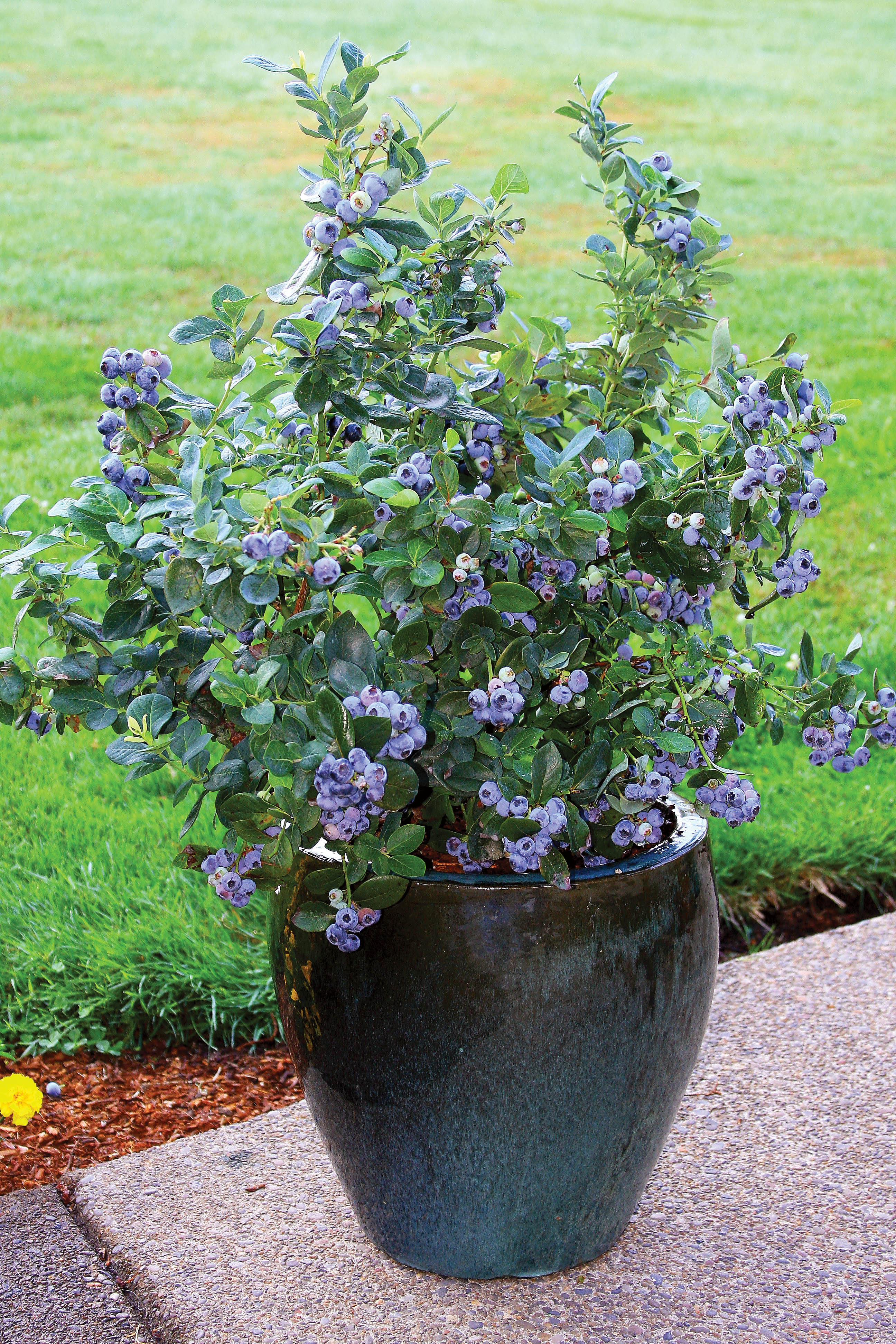
  • Photo from www.fallcreeknursery.com
    • Blueberries: actually grow best in pots because they require high soil acidity, and it's much easier to modify your soil when it's just a few pots. Try to group two or three together to improve harvests. 

      • Top Hat (dwarf)
      • Peach Sorbet (dwarf)
      • Sunshine Blue (semidwarf) 
      • Sunshine Dwarf (dwarf)
      • Northblue (half high)
      • Northsky (half high)
      • St. Cloud (half high)
      • Polaris (half high)
      • Chippewa (half high)
      • Northland (half high)
      • North Country (half high

    • Raspberries: contained spaces are great because raspberries propagate themselves via their roots. They only produce fruit on new growth, so gardeners are advised to cut them down to an inch or so above the soil every fall. This is, funnily enough, perfect for overwintering in the garage, if your garage doesn't go too far below freezing. Mine isn't insulated and pots freeze solid. A couple of these varieties are extremely cold-hardy, but I don't know if that extends to pots. 
      • Autumn Bliss (medium canes)
      • Meeker (upright)
      • Heritage (tall canes, needs staking)
      • Nova (upright)
      • Boyne (upright)
      • Tulameen (long canes)
      • Fall Gold (short canes)
      • Raspberry Shortcake (dwarf)
    • Strawberries: any variety will produce fruit in containers, but shoot for day neutral and alpine varieties, since June bearing and everbearing varieties tend to need more space, and, in the case of June bearers, send out lots of runners. I was growing some white pineapple alpines, but I repotted them and they all died. This is why I'm concerned about transplanting things. 
    • Photo from http://www.kathrynseckman.com/

      • Evie (day neutral)
      • Albion (day neutral)
      • Seascape (day neutral) (I just bought one of these)
      • Mignonette (alpine)
      • Rugen Improved (alpine)
      • Yellow Wonder (alpine)
      • Any Fragaria Vesca variety (alpine) (I'll be growing two of these: White Soul and Woodland Strawberry, and I killed a bunch of Pineberry Fruit when I tried to repot them)
    • Blackberries: thornless varieties exist! Most if not all of these are thornless, making them easy to handle if you need to move them. It also looks like most of them require trellising, so space requirements might be way too high for apartment dwellers without a roof.  
    • Photo from http://forums2.gardenweb.com/
      • Loch Maree (upright)
      • Black Satin (upright)
      • Chester (upright)
      • Hull Thornless (upright)
      • Boysen (trailing)
      • Logan (trailing)
      • Arapaho (upright)
      • Navaho (upright)
      • Apache (upright)
      • Helen (upright)
      • Loch Ness (upright
      • Triple Crown (upright)
http://www.rhs.org.uk/Plants/Plant-features/Blackberries-and-hybrid-berries

  • Fruit trees: Any dwarf variety can be grown in a large enough pot. Citrus and other warm weather natives will live inside during the winter and be happy, but you'll need to overwinter deciduous trees somewhere less cold than outside if you live somewhere that gets too cold (I feel like zone 5 is when you start needing to take pots inside, but that might be a despicable lie). I'm not going to list varieties because I am done with making this list and also, just go to a local nursery and inquire after dwarf fruit trees. 
Coming sooner or later, probably later, if ever, let's face it: A list of zone 4 friendly plants and plants that do well in short seasons!
This next list will focus on plants that can thrive in containers in my particular hardiness zone, with my local short growing season (because it snows until April and freezes solid in November). I'll be relying heavily on this post, which does a fantastic job of making it stupid-easy to plan gardens no matter what hardiness zone you live in. Also it helps you find your zone. 

13 March 2014

RE: Personal Space -- Ninety Fourth Post

I recently watched a video about how white people should please stop trying to touch black people's hair. This really impacted me because I have been guilty of trying to touch my dear friend's hair, much to her annoyance. She is black. Anyway, I realized that invading other people's personal space when they don't invite you to do so makes you an asshole. I should know this already because I despise having my personal space invaded with a deep and fiery passion, but I invade others' personal space "because it's funny" when they get mad. Which makes me an asshole.

Damn it. Say it with me: I am an asshole. And I'm going to try and stop being an asshole right now.

Anyway, what started off as white guilt turned into a longer thought process about how white American thinks it's okay to invade your personal space if you are "different." Different here includes being any color other than white,  having hair texture and length other than "fairly straight" and "about shoulder length-ish" or hair color outside the common hair colors seen on white people, having an out-of-the-ordinary body shape (including pregnant), and sporting any body modifications including tattoos and non-ear piercings. This is mostly focused on women, because I am a woman and I can really only write my experiences (although I do try to be inclusive of non-me people, I know that I often fail) and also you don't hear a lot of stories about people randomly touching men except old white men playing footsie with cops in sex stings.*

Most people that I know won't just randomly waltz up and touch you unless they know it's not a big deal, or they think you're pregnant. But being outside of what white suburban America is convinced is "the ordinary" in any way makes white suburban people really curious. And, unfortunately, we're pretty much toddlers and have to be reminded to look with our eyes, not with our hands. In our defense (because I didn't mean to be an asshole), we often just think you are cool and different, and white culture has simultaneously and paradoxically made everything "different" both "other" and cool. It's the same thing we do with trans-gender surgeries: we objectify people by fixating on their physical characteristics.
I'm sorry.
One of my personal asshole issues is cultural appropriation. I think that the Dia de los Muertos celebration is really cool and has really pretty costumes and is a really rich historical and cultural thing, but that fact is that cultural appreciation is one thing and cultural appropriation is another. I'm not hispanic, I don't have that background or know anyone who wants to share it with me, so I'm just going to back the fuck off. It doesn't matter that I'm not trying to steal the celebration, the point is that it's not mine. And, also, by "not hispanic" I don't mean "brown and from an American country south of the US." I know blonde, white-skinned, blue-eyed hispanics; for me, ethnic identity is about history, not color. My ethnic identity is sort of "none" because "white suburban American" isn't an option.
It makes me kind of sad, actually, because I want a family history steeped in traditions and culture but what I've got is just a bunch of white people growing up, getting married, making babies, and living above the poverty line in America. There's a theory based on a photograph that one of my great-etc-grandmothers was Native American, but she always swore up and down that she was white because being a person of color used to mean that you were a second-class citizen in the US. So, I got nothing. Poor me, no one ever oppressed my ancestors :(
Okay, back to the topic of this post.

This is really actually focused on the bohemian-wanna-be, hipster-affiliated, liberal, white women who can often be found at liberal arts universities or working five miles off campus in that trendy establishment. You can often recognize them by the way their pinterest boards are covered with pictures of tattoos and hairstyles that look effortless and messy but in reality take twenty minutes, five hands, and three kinds of hair brush to accomplish. Currently, their clothing of choice includes high-waisted pants and shorts, loose blouses, and too many bracelets. If they approach you and you have anything out of their ordinary, be warned that these thoughts may be running through their heads:

  • "Your hair is really cool, I want to know what it feels like because it isn't like my hair." Picture this, women with straight hair: you spent five hours trying to get your hair to go into curls for prom and you're extremely pleased with how it looks but nervous that it won't last the night. Now someone comes up and runs their hand through it. Maybe it's ruined, maybe it's fine, but the point is, you didn't want them to touch your hair. 
  • "You have a tattoo, that's so cool! What does the skin feel like?" First of all, don't touch tattoos at all until they're all the way healed. Second, NO. We look with our eyes. If you want to know that badly, just get a damn tattoo. 
  • "Oh my god is the baby kicking?!?!? You're making a tiny human, so I'm going to touch the place where you're keeping it." This one's just creepy. Disclaimer, I don't feel that way about pregnant women. But, judging by the stories about random people touching pregnant women, a distressing number of people actually think that way. What the fuck, people. 
  • "Wow, you pierced that? ...What does it, y'know, feel like? Can I touch it?" This applies to facial, oral, dermal, belly button, and surface piercings as well as to nipple and genital piercings. It also applies to gauged ears. If the hole is big enough to stick a finger through, or looks that big, someone will want to stick their finger through it. Firmly dissuade them. Remove their hands from your person if necessary. Piercings don't heal fast, as a rule, and it's easy to get them infected or what have you by touching them with your grimy hands even if they've been healed up for ages. 
  • "Your skin is so different from mine and it looks really pretty. I wonder what it feels like?" I guess "pretty" doesn't always run through people's heads when they see non-white skin, but that is because they suck. Everyone's skin is pretty. But that doesn't give anyone the inalienable right to touch it without your say-so.

"What does it feel like" is a common theme here. A lot of white suburban Americans in academia, at least, have this idea that because a lot of the people who founded colonies on the American continents were white-ish (I'm including the Spanish in my "white" term because they're historically caucasian in skin tone), to be a white suburban American is to be an explorer with a curious mind who must always be discovering new things. Unfortunately, we do have a lot of that good old colonial spirit because we like discover things that people are already doing.
Picture this: you just ran the boston marathon and got your goddamn medal thing because you ran twenty six fucking miles and then someone comes up with a fake boston marathon medal. They congratulate you on running the race and proudly display their fake medal, saying "I didn't run in the race, but I think that the boston marathon medals are so cool that I just had to have one. Why are you mad? I'm showing support! You should be grateful."
As a white person with no ethnic identity, this how it looks to me when white people appropriate culture.
People with ethnic identities: please tell me if I'm horribly wrong and should take this post down and stop pretending like I know how you feel and putting words in your mouth.


*I don't get sex stings. If no one's getting paid for consensual sex, isn't it legal no matter how many (or few) penises are involved? Please, please correct me if I'm wrong, because (1) I need to rethink my life and (2) I don't want to be right if consensual sex is wrong.

18 February 2014

Dermal Implants: What to Do and What to Avoid -- Ninety Third Post

I recently got two dermal implants in my collarbone. The second picture down is what they currently look like. I’m pleased with them, but I’m not exactly boasting about my bruised collarbone with the creepy hole in it just yet. Anyway, I thought I’d make a little list of things to do and things to avoid when getting dermal piercings.
First things first: what the hell is a dermal implant? They go by many names, including dermal anchors, dermal piercings, and microdermal all of the above. They’re closely related to skin divers. Dermal anchors have these little holes in them so that the tissue grows through and holds the implant in place while skin divers are just a little flat disc that sits under your skin. They’re not really related to surface piercings (eyebrow and belly button being the most common ones I can think of) because while both are in the plane of the skin rather than through it like a traditional ear, lip, nose, or tongue piercing, surface piercings still have both an entry and exit wound. Dermals are single-point piercings, so they don’t have an exit wound. This makes them the most likely to reject and fall out.
So here it is.
DO’s and DON’T’s of Dermal Piercings
DO look up lots of pictures of people with dermals where you want a dermal, if you can find them. You probably can. Make sure you really want it; this isn't like a traditional or surface piercing that you can just take out if you don't like it. You have to slice it out of your skin if you want to get rid of it.
DON'T watch YouTube videos of dermal implants unless you handle pain better when you know what's going on. Personally, I can handle pretty much anything as long as I don't see it happening. I’m really only squeamish about my own body, so I had a few freak-outs afterwards about how I paid someone to punch two holes in my chest, but I was fine during the procedure.

DO consider the impact this will have on your lifestyle. If you can't wear loose, comfy bottoms that don't put pressure on your hips, don't pierce your hips until you have a long vacation. If you always sling your purse or messenger bag across your body, make sure the piercings aren't underneath the strap. I switched which shoulder I put my bag on a few months before I got the piercing. If you swim or are pretty much any kind of competitive athlete, you should probably reconsider, at least until the off season. And, just like any other visible piercing, make sure your employer is cool with it BEFORE you pay someone to surgically implant jewelry into your skin.
DON'T pay attention to what other people say about how much it hurt. I thought my nose piercing hurt more than my dermals, and it made me cry while the dermals didn't, but lots of people will tell you it's the worst or the least or whatever. It hurts, and it takes longer than a standard ear or nostril piercing, but I'd say that severe menstrual cramps are worse in the long run. The fact remains that this is an incision, not a simple hole-punching.
DO pay top dollar for this piercing. Getting a dermal implant is technically a surgical procedure; you need a little more training to do it right than you do to pierce earlobes, which, for your information, can be done successfully by a fifteen-year-old in her room with her mom’s sewing needles, an ice cube, hydrogen peroxide, and matches. If you want to keep the damn things under your skin, it’s worth it to find a professional who’s been trained to install dermal anchors.
DON'T be drunk or caffeinated or on any kind of blood thinner. You'll probably bleed some anyway, but you'll definitely bleed all over everything if your blood is being thinned out by anything. And being drunk before a piercing is just a terrible idea anyway, even if your piercer does allow it. A word to the wise: reputable piercers will not pierce you when you're drunk.
DO eat at least half an hour beforehand. You're that much less likely to faint if you've got some food in your system.
DO make sure you like the top. You're stuck with it if it's a skin diver. Most anchors have interchangeable tops, but it’ll be at least two months before you should even think about touching it. And even then, you should probably have a professional piercer change it out for you.
DO remember to breathe while you’re being pierced.
DON'T breathe too hard or you'll increase your blood flow and bleed all over the place.
DON’T panic if it takes longer than you think it should to finish the piercing process. If you’re smart and picked a good tattoo/piercing parlor, your piercer knows what they’re doing. Dermals can be tricky to get in all the way, especially if you have tight skin. My whole procedure, with two anchors, took almost an hour because the second one wouldn’t go in all the way. Now I have a massive bruise around it and a sore pectoral muscle. But hey, it’s in! It’ll be cute in a few days when it stops looking like I’m a zombie.
DON'T take a picture and put it on Facebook while you're still in the parlor. No one wants to see your super badass and/or cute piercings when they still look like you've been mauled by a bear and/or shot. It will look as cool to everyone else as it does to you after it’s healed.
DO expect blood, exotically colored bruises, and some painful accidental contact with your new body mod.
DO understand that people who don’t have or want dermals themselves may be weirded out or grossed out by your fancy new decorations. It’s your body, so I hope that your friends will be supportive and not make you doubt your choice to spend a large amount of money having someone punch holes in your body, but be prepared for negative responses.
Here's few examples of how dermals look to different kinds of people:
How it looks to you (perfect/cool/cute/badass/your adjective of choice):
Stolen from some random place on the first page of a google image search
 
How it actually looks:
That's me, my dermals, and a little bit of my cleavage. Hello, cleavage. Make sure you can see the yellow/green bruise around the white arrow pointing to the text about the meat tenderizer; you may have to tilt your monitor.
How it looks to someone who thinks dermals are gross:
I have no idea what that is actually a picture of and I don’t want to know, although I think it might be someone’s head. I’ve been watching Supernatural (it’s like crack; I hate horror movies and yet here I am, watching a horror movie in TV show format) and I feel like I’ve seen it before in one of the particularly gory episodes.
And you’re welcome. Scouring google images for “infected dermal piercing” images is not a fun experience, let me tell you.
DO wait a week or more for the bleeding and bruising and swelling to taper off. The picture of me up there was taken five days after piercing, and the bruising is just fading to green and yellow from the rather attractive purple it started out as. Healing takes time.
DO remember that you’re trying to convince your body to accept a piece of metal as part of itself. This is true for every piercing, but dermal implants are the best candidates for rejection because they’re single-point, not threaded through the skin like every other piercing. Your body can just shove the foreign object out of itself if it gets infected.
DON'T fucking touch it. This is a direct quote from my piercer. Just don't do it. It hurts and you'll get yourself infected in no time. Once you're healed up, it's probably okay to touch, but don't make a habit out of playing with it.
DO clean your dermal anchor with salt water (about half a teaspoon of non iodized sea salt in a cup of warm water works well), filtered tap water (if it's safe to drink, it's good for cleaning your piercing), or sterile saline solution (like for contacts). If it's on a large flat surface like collarbone or hip (right next to the eye, on very small wrists, or behind the ear might be tricky, but fingers you can just soak in a bowl or something), fill a shot glass with your preferred cleanser and hold it over the piercing. This lets it soak and gently softens any crusty gunk on days when you don’t take a shower.
DON'T use soap on it, at least until it's fully healed. Soap plus open wound with foreign object equals pain and rejection. Clarification: if it gets infected after the initial healing period, feel free to use antibacterial soap around the infected site. It's worked to clear up all my infections and proto-infections (not oozing or hurting, but starting to swell), and it's much faster than waiting for them to heal up on their own.
So, yeah! If you’re thinking about getting a dermal, I would say go for it. The only caveat is that if you think you might have a job someday where cool body mods aren’t allowed, don’t put it in a super visible place (like your face). Removing a dermal anchor safely requires a surgical procedure similar to the one it took to get it in, which is expensive, and will undoubtedly leave a scar. I plan on being a scientist forever, so piercings and tattoos are no big. Even if I end up teaching, I should be fine because it’s easy to cover up the collarbone with a scarf, jacket, or, worst-case scenario, bandaid, and I’m not even sure that colleges in fifteen to twenty years are going to hate on visible body mods.

01 January 2014

Happy Freaking New Year - Ninety Second Post

I don't have any new years resolutions. At least, I didn't when I started this post. A new year is just a new day, after all, and I don't have the money to initiate any radical lifestyle changes just yet. I'd like to eat healthier and exercise, but winter isn't the best time to start trying to motivate yourself to do something unpleasant, like exercise in the cold, and my paycheck comes in a few weeks, so no fancy expensive health food for me until then. So, no big resolutions are really possible for me at this point.
I don't really get the whole hubbub around the new year. Yeah, it's a new year, but I'm not that old and I've already experienced 23 first days of new years. Now those years are old and gone. in a few years, I probably won't be able to recall anything more about 2014 than I can about 1994 (that is, a few snippets that blur together). There's a statistic floating around the internet that says that 8% of New Year's Resolutions are actually kept, so according to that, I won't be able to keep a resolution worth beans. Why bother with all the pomp and circumstance? I'll just bide my time and enact small but important lifestyle changes when I can gather up the motivation and funding necessary.
2014 is going to look different from 2013, mostly because I have the full time job that is grad school. No graduation in the spring this year, and no moving from state to state and panicking over the lack of housing. I'll still be scrambling to pay school fees and wishing I had more time to do outdoorsy stuff, but it'll be with the promise of a regular, salary-dependent paycheck coming soon.
No  more Whitworth, except via the mail they send me in hopes that I'll cough up more money (and heaven help the poor kid doing phonathon who has to call me).
Some similarities are to be expected. I'll be teaching labs again and enjoying that warm feeling inside when a student gets excited about science. The difference is that now I know that I like teaching, whereas I started 2013 not knowing.
I suppose I do have resolutions, of a kind, for the year. I want to save up and buy a new computer, since this one is slowly and steadily breaking down (the DVD drive went out, and the CPU is always running at 90% or higher). I also want to save up for a car, but that will have to wait for the computer. I can live without a car, obviously, but this computer is going to kick the bucket sooner or later and I can't afford to live without a computer. Being in charge of other people's grades is a huge hassle when you think your computer might die.
Just for the heck of it, I'll resolve to try indoor rock climbing this year. This way, when someone asks what my resolutions are, I can give them that one. Plus, I started off 2014 by eating chocolate while writing blog posts at 2 AM. I don't think any "healthy living" resolutions would have lasted past that little set-back.

Anyway, happy New Year if you're into that sort of thing!

14 November 2013

Graduate School, Part the First - Ninety First Post

I write this post from the groggy depths of the third month of my first year of grad school. I have three weeks of ungraded lab reports and five weeks of ungraded quizzes littering the floor of my room along with a bunch of junk that needs to be cleaned up.
Grad school has changed me, man. I'm not saying that I'm the most socially competent person at the best of times, but I'm pretty sure that I've only gotten worse.
I usually have any number of conversation topics to which I can contribute: movies and TV shows I've watched, school, plans for the weekend, weather, books, food good and bad, love interests, nail polish and makeup, working out, etc. Now, however, I'm down to only a couple: Class, research rotations, students, and grading. Fortunately, I only hang out with other chemistry and/or biology grad students and my gen-chem students, so these topics are completely acceptable. I'm practically a socially competent person when I hang out with other science grad students. Other than school topics, I can kind of contribute to weather and food, but all my weekend and evening plans can be summed up as "grading and homework" and as far as love interests go, everyone I know is either already in a stable, long-term relationship or has no desire to complicate their life with that right now because OHMYGODSOBUSYGAH. I fall into the latter category. Honestly, I barely have time to take care of my fish, who needs to be fed about every other day, so how on earth would I have the time to devote to a romantic relationship? That seems like a massive time commitment that I'm just not in a place to make. Also, responsibility. Man, I feel like a kid again. I mean, I cook my own food and make more than $500 a month, but a distressingly significant subset of my high school and middle school compatriots are married; an even more distressing number have actually procreated.
I struggle to take care of a fish and a couple houseplants and still get all my shit done; kids?!
nope-nope-octopus

I actually have several first-year chemistry program classmates who are married and/or have kids, and oh, man. If I am stressed, how do they even live?
And stress: I've got the classic symptoms. I really do have things undone all the time, so there's always that on my mind; I sleep poorly when I do get to sleep; and I'm not just groggy from lack of sleep but also from a delightfully persistent head cold.
Normally, I can go to sleep and wake up around 8 hours later, maybe as many as 10, on my own. Last night, I fell asleep at 7 PM and woke up reluctantly at 7:30 AM when my alarm went off. Accounting for the brief interludes where I remember waking up and rolling over, I slept for no less than 12 hours and was still kind of sleepy when I got up. I blame this on the constant stress and the fact that I normally sleep fewer than seven hours a night.
I do sleep regularly during class, though. I'll be taking notes one second, then the next second, I wake up! Or I'll be taking notes and my eyes will shut all by themselves. At that point I usually give up and hope that I wake up before everyone leaves and that no one calls on me to talk while I'm still asleep.
As far as classes go, my classes are all literature-based. Literature-based classes are easy, from an "absolute minimum of effort required on a weekly basis" standpoint. The hard thing is taking in all the information and getting a coherent response to it ready in time for class. Then there's a mad rush to read a bunch of papers so you can write a paper summing up and extrapolating new information and opinions from the papers you were supposed to be reading all semester. Really, what you get out is proportional to what you put in, so I probably won't be getting a lot out of my classes this semester.
Well, that's not entirely true. I know a lot more about how to read papers and how to avoid falling out of my chair while napping than I did at the beginning of the semester, and I did learn things about proteins, DNA, and polymers from my classes, which is what the classes were supposed to teach me. But there are students who I know were super motivated and who read every single paper and who spent hours and hours on any homework assignments we happened to receive, and then there's me who read only the papers that we had to write papers about and spent maybe an hour on that homework assignment including research.

I feel bad. I feel like grad school isn't about scratching the surface, but it's what I'm doing every day. I scratch the surface with my gen-chem students, because what is gen-chem but scratching the surface of all fields of chemistry? I scratch the surface in class because I don't have the energy to fulfill my TA duties, complete homework assignments that aren't too bad, and also gain deep understanding of all the dozens of topics we cover in class. I scratch the surface in my research rotations because I have too many jobs (teaching, classes, etc.) to really get into a project. Finally, I only scratch the surface in my nascent friendships because I don't have the time to really get to know people.
And it sucks. I have a lot of introvert characteristics, like I hate making small-talk because it feels like a waste of energy and I only get close to a few people, but I feel like an extrovert right now because I do need those close friends to be happy. I need people to talk to, or I get all out of balance and can't focus on things.
This post was supposed to be funny, like "OMG grad school makes you crazy! Mad scientists! Lawls!" but then it turned into this depressing monster that has a funny gif in it.

Okay, positive thinking. I really do like teaching. I hate grading a lot, but teaching has been a pleasant experience so far. Since I'm a fyoung and relatively diminutive female (age 22 at the beginning of the semester, 5-foot-six in hiking boots), I was afraid that I would get douchebags in my class who would reject my authority and make trouble in class. However, all the guys are at the very least respectful to my face. None of the older, non-traditional students who I feared would have a problem with my age have posed any kind of a problem; they're typically the best of the bunch. I even have a couple students who really like science, which was more than I expected. Probably the best moment since moving except for when I found my favorite egg drop soup mix online was when a student brought her experiment over to me to show me that it was working. That same student once emailed me excitedly to tell me that she finally understood the material.
Here is a play-by-play of how these sorts of interactions go for me:
Student: "I am excited by this science!"
Me, internally: (dances with joy) YES! YES! A FLEDGLING SCIENTIST! MAYBE THEY WILL DO GREAT SCIENCE OMG OMG THEY LIKE SCIENCE! I WIN AT TEACHING! (dance, dance, dance!)

Me, out loud: "That's great!" or something boring to that effect.


Most of my subdued response is probably because of the fact that if I freaked out and started happy dancing in the middle of lab, I would probably scare all of my students and have to take drug tests.

28 October 2013

Growing Experiences -- Ninetieth Post

First off, the new blogger format where you can't tab quickly from the title to the body of the post is really annoying. I don't know if I said it before, but it's worth saying again.
Second off, I just had a growing experience and hated it thoroughly. I actually had it a few months ago, but I've been too busy to post the perfectly viable draft that I wrote right after it happened. The problem with this one was the extended stress levels. I moved to another state with hotel reservations for the parents and brother for three nights; this was after graduate housing fell through (they contacted me today saying they would have a place in September; thanks a heap, Coyote Ugly). I had a few meetings set up to look at apartments, and made a lot more as the days went on and I couldn't find anything. I don't think I encountered too many craigslist scams, but I saw a few kind of awful places, didn't sleep well due to snoring in the hotel room, had a couple places get snatched out from under me, and eventually ditched the whole "my future-roommate can move in later" plan as living on the street became more of a possibility. Finally, I decided to look for rooms to let in established places; i.e., I would become a new roommate in a house full of strangers who already knew each other. As a quick recap, junior year fall was great because no one knew anyone, but junior year spring was awful because everyone but me was already established. Still, it would better than being homeless. 
I hated this growing experience. I had to make phone calls and put my phone number on the internet (via craigslist emails) and meet lots of new people. 
And, while I hate the way my stomach still hurt from the stress as I wrote this three days after moving in, I feel pretty good about this whole endeavor again. For a few weeks, I was wondering if I was even supposed to end up in grad school, given the way housing was working out (or not working out, as it were). I was so stressed that I was getting tension headaches because my stress apparently settles in my shoulders and neck. Once we started the trip over here, I started not being able to eat a whole lot; you'd be amazed by how unappealing most food is when your stomach is twisted up and you feel like you could dry heave at any point. I mean, water made my stomach hurt. Breathing made my stomach hurt. 
Anyway, I found a place where I could move in immediately with nice people, two dogs, a flight of stairs between me and the kitchen, a washer and dryer, a monthly lease (nice if things don't work out), a nearby bus stop, and the cheapest rent I've ever seen in a four-person home. It's a mere ten dollars more expensive than my last place, with its unfinished basement and six people, and almost a third of the average rent in the area. 
Bam. 
Now I'm free to stress about (in approximately this order): 
1. Orientation
2. Preliminaries (have been too busy moving and stressing to study)
3. Teaching 
4. Teaching
5. Teaching
6. Class

But hey, this is what I signed up for. If I can meet someone and move into their house the same day, well, I can teach three labs of probably-won't-be-science-majors-after-this-semester undergrads. 
Also, I bought a bike for $80 and spent almost twice that much fitting it out with fenders, lights, grips, a kickstand, and a helmet. And I still have enough money to pay rent next month. And I can pay utilities.
Once I figure out how this house works, life will be pretty good. I've already almost forgotten the bone-crushing, vomit-inducing stress that comes when you have to be out of the hotel TOMORROW and school activities start in THREE DAYS. In the meantime, I'm still working out whether or not to use the dishwasher and how long the dryer takes to finish drying my sheets so I can go to bed. It seems a lot better than worrying about where I'll be sleeping tomorrow.

UPDATE: It's been a few months since orientation now, and I can hardly remember it. I've made friends, I've make mistakes, and I've made good choices. As far as I can tell, grad school is like having a teaching job, with all that stress and work, smashed in with having serious classes in school and a part-time job in a research lab. So, like real life but more stressful.
I regret nothing.